
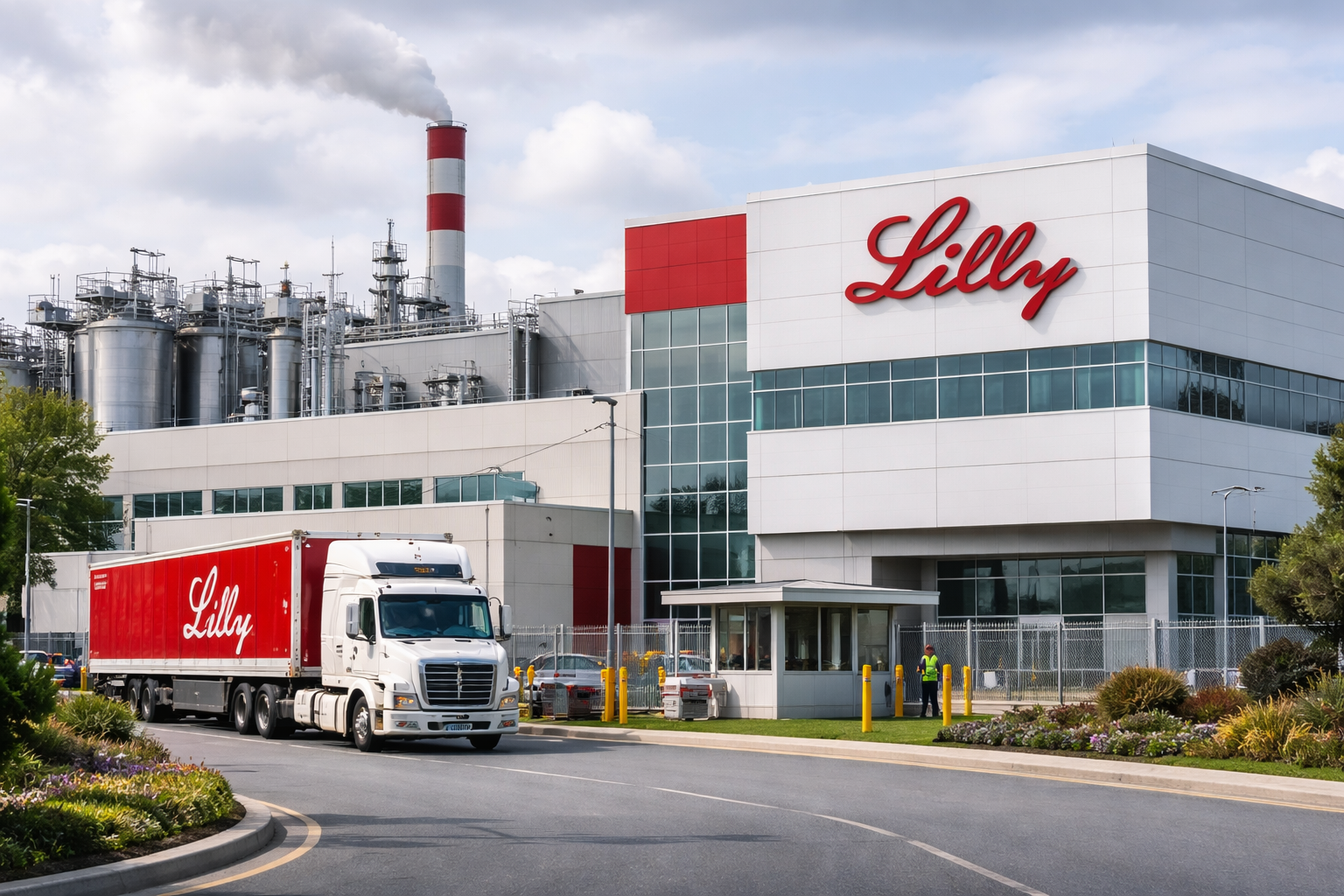
Shares of Eli Lilly came under pressure on Tuesday after HSBC downgraded the stock, raising fresh questions about whether the pharmaceutical giant’s strong run in the obesity drug market can continue or if investors should reassess valuations.
The stock slipped 4.2% following the downgrade, even as it remains one of the best-performing large-cap healthcare names over the past year.
Lilly shares are still up about 14% over the last 12 months, sharply outperforming rival Novo Nordisk, whose stock has declined more than 54% over the same period.
Valuation concerns drive downgrade
HSBC analyst Rajesh Kumar downgraded Eli Lilly to “Reduce” from “Hold” and cut the price target to $850 from $1,070, citing concerns that the stock may have run ahead of fundamentals.
Despite the downgrade, the analyst did not turn outright negative on the company’s business execution. Instead, the key issue appears to be valuation.
Shares are currently “priced to perfection,” Kumar wrote, suggesting that much of the optimism around Lilly’s growth prospects is already reflected in its stock price.
The downgrade reflects a growing debate among investors over whether the obesity drug boom can sustain current expectations, particularly as competition intensifies and pricing dynamics evolve.
Obesity drug market expectations under scrutiny
A major driver of HSBC’s cautious stance is its revised outlook for the total addressable market (TAM) for obesity drugs.
Kumar believes consensus expectations of a market exceeding $150 billion are overly optimistic.
Instead, he projects the TAM will fall between $80 billion and $120 billion by 2032.
This reassessment comes as pricing pressures increase across the sector, particularly with competition from Novo Nordisk, the maker of Wegovy.
“Rising working capital intensity at Lilly, headline price pressures, and rebate dynamics at both companies indicates to us that the pricing dynamics are likely to get worse,” the analyst wrote.
The divergence in outlook between Lilly and Novo Nordisk has also raised concerns among investors.
“The divergence of Lilly’s guidance with that of Novo has been puzzling, not just to us, but most investors,” Kumar added.
He attributed part of this gap to Lilly’s success in the cash-pay channel, which he said is driven more by pricing than product differentiation.
Pipeline risks and competitive pressures
While Lilly continues to expand its obesity drug portfolio, HSBC also flagged potential risks tied to its upcoming products.
The launch of the once-daily orforglipron pill later this year is expected to broaden access to weight-loss treatments. However, Kumar cautioned that expectations may be too high.
“We think that the compliance and persistence of these drugs might disappoint,” Kumar wrote.
Current market estimates of $1.1 billion to $1.3 billion in 2026 revenue from the drug are viewed as optimistic, especially given that they are partly anchored to Lilly’s $1.5 billion stockpile in pre-launch inventory.
At the same time, Novo Nordisk is expected to compete aggressively, with pricing pressures likely to intensify as both companies seek to capture market share.
Despite these concerns, HSBC emphasized that healthcare remains an attractive sector overall, describing it as a relatively defensive space amid broader macroeconomic uncertainty.
For Lilly, however, the key question for investors is whether the recent pullback represents a buying opportunity or a signal that expectations around the obesity drug market may need to be recalibrated.
According to TipRanks data, 16 of 19 analysts gave a buy rating, 2 a hold rating, and 1 a sell rating, with HSBC’s being the sole sell rating.
The consensus analyst rating for Eli Lilly remains positive despite HSBC’s cautious warnings.
The post Eli Lilly falls after a 6 month rally; is this a buy the dip opportunity? appeared first on Invezz