
The US stock market has seen a massive reallocation of capital toward artificial intelligence (AI) infrastructure stocks in recent years.
Yet, a paradox has emerged – several of the sector’s most indispensable leaders are still trading at valuations that arguably discount their multi-year growth trajectories.
For disciplined investors, bargains are no longer found in distressed assets, but in high-scale names where market pricing fails to account for exceptional backlogs and supply-side constraints.
Three of such picks are Microsoft, Micron, and Nvidia – representing a triad of foundational plays spanning the cloud, memory, and compute layers that currently offer rare entry points.
A simple analysis of their forward earning multiple against projected capex cycles through the end of this decade presents a rather compelling case for long-term accumulation.
Microsoft (MSFT): capitalising on $625 billion backlog
Microsoft stock remains a cornerstone of the generative AI economy, primarily through Azure’s role as the essential computational muscle for enterprise-grade models.
Despite its market dominance, MSFT currently presents an attractive valuation anomaly – on an operating P/E basis that isolates core profitability from volatile investment gains – it is trading at levels reminiscent of the 2023 trough.
And that’s when the titan boasts a remarkable $625 billion commercial backlog, providing a level of revenue visibility that only a handful of its peers can possibly match.
As companies pivot from AI experimentation to full-scale deployment, MSFT’s ability to capture incremental margins through its OpenAI partnership positions it as a defensive growth play hiding in plain sight.
Micron (MU): leveraging an HBM supply deficit
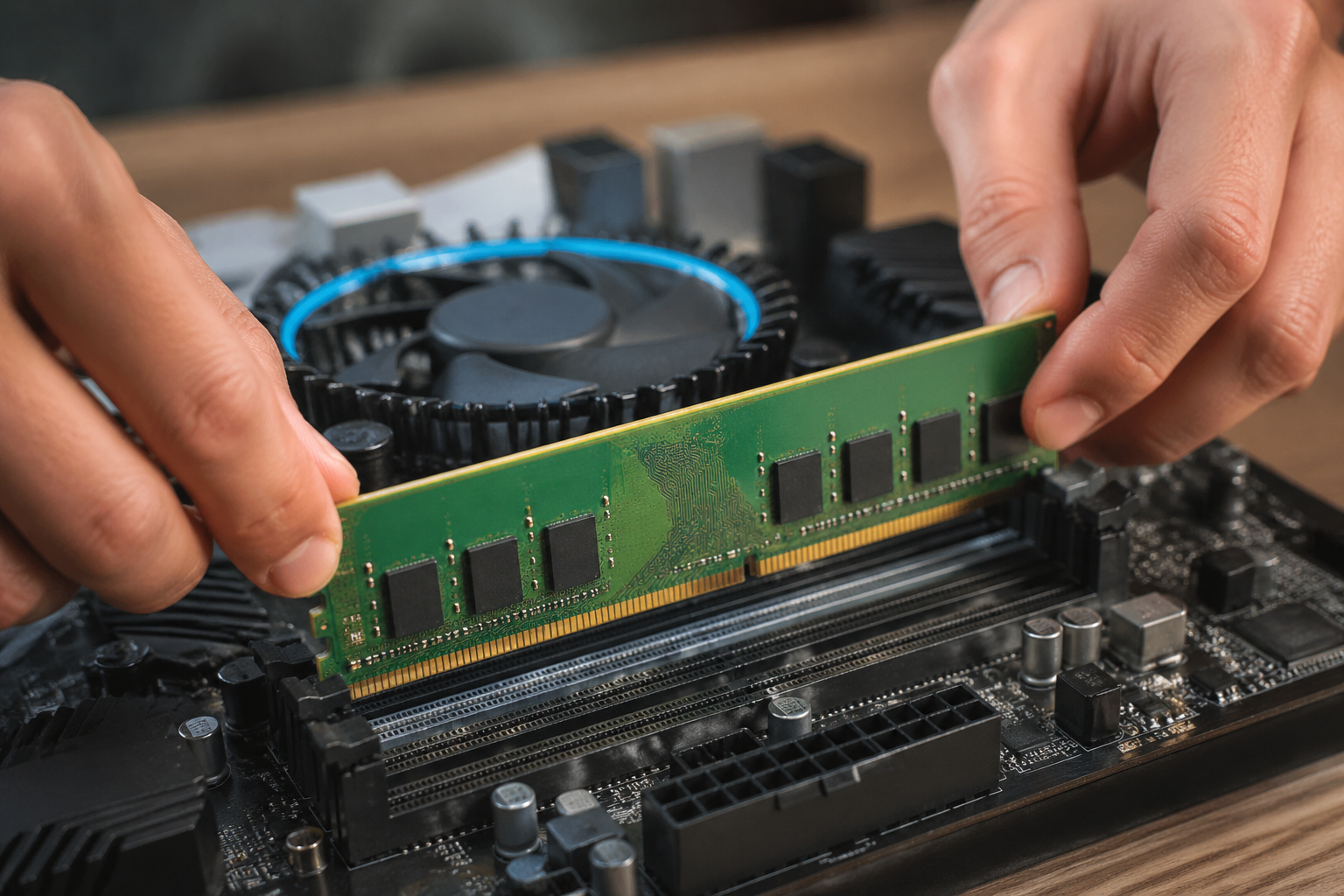
Micron is undergoing a fundamental transformation from a cyclical commodity manufacturer to a high-margin provider of critical AI infrastructure.
According to the multinational, it’s entire high-bandwidth memory (HBM) supply is entirely sold out for 2026, with pricing already locked in under long-term agreements.
Plus, management sees HBM’s total addressable market (TAM) exploding from about $35 billion last year to north of $100 billion within the next three years.
Despite these secular tailwinds and mouth-watering year-on-year growth rate, MU shares are going for just 8.4x forward earnings.
This reflects a “cyclical stigma” that ignores the unusual durability of AI-driven memory demand, offering a deep-value entry into the hardware stack.
Nvidia (NVDA): a remarkable $1 trillion order book
Nvidia’s status as the world’s most valuable company often obscures its fundamental affordability.
While critics cite its meteoric rise, the market is currently pricing in a success plateau after 2026, a projection at odds with a massive $1 trillion order book for its Blackwell and Rubin architectures through 2027.
Having generated $216 billion in revenue in the trailing twelve months, NVDA is entering an era of unprecedented scale.
Remarkably, the AI stock trades at about 26x forward earnings, representing a small premium only over the benchmark S&P 500 index.
Given Nvidia is monopolizing the compute layer of the next decade’s digital infrastructure, this valuation suggests it’s actually a “growth at a reasonable price” opportunity.
The post These 3 large-cap AI stocks are still a bargain for long-term investors appeared first on Invezz